Jonny Pickton, Student of Design at Futureworks School of Media, Breaking Bad: Methcraft
USPs:
- Build a drug empire
- Manage income and export revenue
- Interactive drug creation
- Hire / fire dealers
- Take on rival crews
Platform: iOS / Android
Concept:
Putting players in the shoes of show protagonist Walter White (roughly around series 2) the player is tasked with building up their very own drug empire through the manufacture of Meth Amphetamine. The game plays much like a resource gathering / management experience similar to "Game Dev Story" or other games by Kairosoft.
Cooking:
During the cooking phase of the game players enter a mini-game like scenario where they are tasked with cooking the drug methamphetamine (through a very stylized and pseudo realistic fashion, much like the TV series) Hitting the correct buttons through quick time events, releasing buttons at the correct time to add the perfect amount of mixtures as well as the iPhones accelerometer. Also trying out different recipes and methods will go to ultimately define the quality of the drug batch (rated in a percentage of purity). The higher the percentage of purity the higher cash value can be yielded from the cook. As the player progress, they can attempt to cook larger quantities of "meth" (which will require various upgrades to the Lab (see next gameplay phase). With the larger quantities comes new cooking methods and as a result more difficult challenges in the mini-game section; making it harder to reach the highest percentage of purity during the large quantity cooks.
Management:
Here players can expand on their profits by venturing into different territory's on the map, hire help and "muscle" as well as upgrade their lab with either tools or new locations.
a) Distribution:
Here players must traffic the sale of their drug into specific locations around New Mexico, being mindful of police presence, buyer percentage as well as outside "heat" from rival dealers. The amount of friendly dealers the player can have on the pay role at any given time depends on the amount of cash in reserve, therefor assigning dealers to the correct most profitable location here is key.
b) Upgrades:
Upgrading the Lab will allow players to cook high purity levels of Meth as well as cook in higher quantities (weighed in pounds) and therefore increase revenue. Upgrades are unlocked as the player progresses through the game and their overall cash banked increases with their "reputation" amongst other dealers in the area.
Beginning with the RV players can expand outwards buying property to increase the size of their Lab and reap the perks of this; yielding higher meth loads.
Wild Cards:
These appear randomly through the game and give the player challenges such as police inspections to properties or the death of one of their dealers. As well as word of supplies which can be stolen or territory that is up for grabs or new meth recipes. These can be used to the player's advantage or will hinder their progress
I wrote a short post mortem with Gina Nordheim for Spin Doctor based on the format from GameCareerGuide.com.
Was pretty fun looking at the project like this and reviewing how it went.
its below anyway. ________
Spin Doctor
- Post Mortem
Over the
second year of our Diploma into game development, students studying at Futureworks School of Media in Manchester, England, were assigned the
brief to create a short beta demo, based on a game concept which would be
designed throughout the year. Our class comprised of 8 diverse students each with their own different history and talents when it comes to game development. The majority of the class have some form of background in their chosen specialism (through hobbies and general interest), however there is little formal education from the combined group into the field of game design and development, other than the first year of our course. The brief assigned presented the class with a very difficult challenge to not only create a game (as well as an engine to run it), but to learn and develop their skills along the way. Specific lessons were tought in each of the 3 specialisms, which were lead by 3 tutors with their own field of expertise. The lessons would provide theory and education into each subject, whilst the tutors were also there to guide the progress of the class and help where possible. Programming, Art and Design were all done in
house and from scratch, by students whom were still learning and improving
their craft. Initially the class worked separately in groups in order to come
up with initial concepts that would form the basis of our demo. From these
short concepts, "Space Game" was selected which simply used the core
mechanic of rotation and gravity to overcome puzzles. This game would later
become the steam punk Victorian world of "Spin Doctor" and form the
basis of our year long project. Programmers were tasked with creating both an
engine and editor to run the game and help the designers create levels in them.
Artists then, were in charge the entirety of the visual content for the game
including asset creation and animation.
The result was a short 30- 40 minute 2D gameplay demo released in August 2012. The
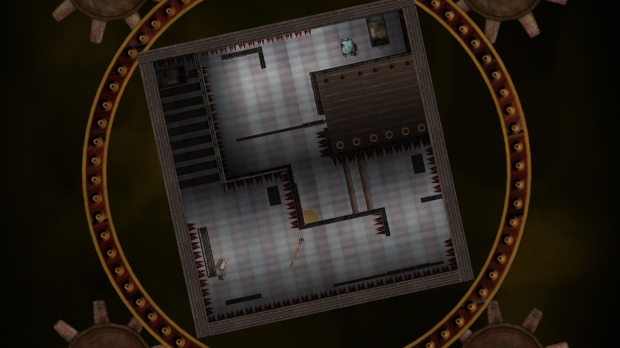
core concept of the game was the use of a rotation mechanic, allowing users to
shift the orientation of the levels and therefore change their route through it
in order to avoid obstacles and hazards. Story elements were added into the
game giving it more depth and playability, following main protagonist Harland
Shears on his journey through a hellish maze of underground hazards and traps
as he seeks to find answers to his strange surroundings and ultimately,
freedom.
5 good
things: Solid core mechanic
One thing that had been maintained throughout the whole project was the use of
the "rotation mechanic" as the main gameplay tool. Story elements,
setting and characters were changed frequently during development, but the
concept of gameplay remained essentially the same. Having this strong vision
for the rules and mechanics early on in the pre-production phase allowed the
class to stay focused and work cooperatively to a shared ideal and goal. Ideas
flowed more organically since the concept was something everyone had already
agreed on and felt comfortable with. This bled into our designs of levels and
elaboration of additional mechanics, all of which complemented the main idea
for the game.
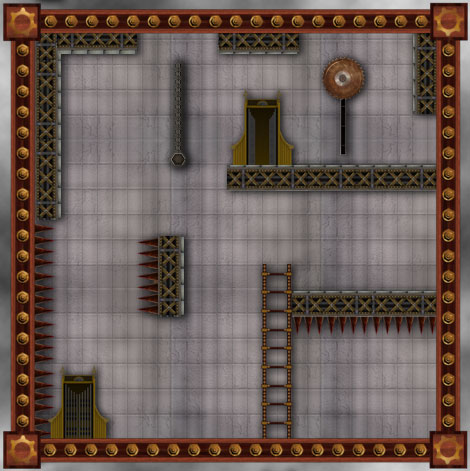
Level from the game using the rotation mechanic.
Abundance
of content
From the early development brainstorming and idea creation phase, it's fair to
say the class had too many ideas for the final vision of the game. This down
the road would help us out infinitely. When ideas didn't work or something
needed to be changed, there was an ocean of concepts for new characters,
mechanics and levels talked about and documented early in the development
cycle. Again, this allowed the team to naturally and organically bounce ideas
from one and other, with all ideas falling back and facilitating our main
mechanic, from our story implementation and characters, to the location and
setting of the final game. Planning
Every aspect of the game was planned out in the pre-production phase of
development. The team spoke endlessly about ideas and brainstorms were
frequent. Everything was documented down into what would become our Concept and
Games Design Documents. The GDD acted as our blueprint for the game and kept
the class up to date and on the same page with development. Whenever team
members had conflicting ideas or misunderstood elements of the game, we could
easily reference the GDD and work from it as we progressed.
Dedication
Only having limited class time, it was important that members were dedicated to
the cause outside of college hours and needed to provide a steady income of
work for the game. Lessons were limited to only 6 hours per-week with each class divided between Design, Art, Programming and Production, on a monthly cycle. Through the dedication of the class we were able to push
through some difficult times and problems we faced through development. The
majority of these problems came from technical and work load issues and could
have potentially crippled the entire project. Problems with programming and
lack of content in the art side of the project were rectified by long working
hours and enthusiasm from those involved, to simply finish the project.
Personal Development
The project allowed each of the members on the team a chance to flourish in
their chosen specialisms as well as adapt and improve other areas of their
development careers. Thanks to the necessity of work the project demanded, the
class was forced to learn new skills and improve on old ones to deliver the
final project. Naturally working on the game has made everyone better
developers overall, however the format of “learning whilst you work” is
something that was really pushed and created a better learning environment.
Everyone would regularly chip into areas outside of their specialisms which
created an overall stronger connection between the classes and helped refine
our ideas down.
5 bad
things: Lack of communication
This became a problem almost from day one when starting this project. The group
tried many methods of establishing strong lines of communication such as weekly
meet ups both in person and on Skype, group emails and finally a Facebook group,
which would act as our private social link to everyone in the class. Using
Facebook worked the best and ensured we could be in constant communication.
However, the laid back nature in which this was approached meant people would
frequently be kept out of the loop on important areas of the project, which
lead to confusion and overall decrease in moral and productivity. Work was
forever being chased and deadlines missed, pushing back the workload of the
class and creating stress and tension.
No working procedure or format
Once we hit production phase, without any methods of work submission there was
much confusion into where documents were and just who was working on them. At
times we even lost digital copies of important documents like the Proposal Doc.
A shared group Dropbox account became our primary way to distribute work
through the class. During asset creation the Artists had a difficult time
advertising new versions of their work and sending them over to the
programmers, which brought more problems through image formats and sizing issues.
The closing months of the projects saw new builds of the engine and editor
being completed almost daily. Keeping up with this steady stream of updates
meant members of the team were using back dated version to complete levels.
This confusion hindered progress and made the production process for convoluted
and confusing.
Over
ambition
From the outset we know the goal of the project was to complete a simple but
effective 2D game. During the idea creation and pre-production phase work
flowed smoothly and kept to a relatively good standard. Once production rolled
round however and the class fully realized the scope of what we had planned and
how much work needed doing (specifically from a programming side) we started to
struggle with work load. Poor attempts at rationing tasks across the class lead
to more confusion and slowed development even further.
Prioritized work incorrectly
At times during development the 3 areas of our project, design, art and
programming, would progress at different levels based on the classes opinion of
importance. Initially, design was focused on more than any other area which
left the programming and art creation during the concept phases lagging.
Eventually these areas would catch up, but not at steady rates. There was times
when designers needed to use parts of the editor to craft levels for deadlines,
when the editor was unusable through programming issues. Likewise at times when
art was expected, artists were bogged down helping in design areas.
Lack of a project lead / manager
Whilst planning was something that worked perfectly, the ability to maintain
strong lines of communication and risk assessment fell short. Implementing a
project lead who could act as a buffer for all 3 areas of design and keep track
of workload and deadlines, would have ensured a more structured path through
development. Without this, the confusion that arose in all areas became worse
and with no-one to look for in times of management needs (or indeed blame when
things went wrong) the team suffered.
Conclusion Overall the class worked on the game for roughly 7/8 months (with other class orientated assignments throughout the year). The result is a pretty satisfying game that far exceeded our goals at the beginning of the year. Spin Doctor perfectly showcases how hard work can pay off and has become something we`re rather proud of; more so for a team of inexperienced designers. It wont be winning any awards, but we are more than happy to showcase Spin Doctor as our first game ever created as a class. Lessons learnt will be carried over with us to the 3rd year of our education, where we will hopefully go onto making something pretty special. Watch this space!
More info:
Title: Spin Doctor Platform: PC Release Date: 31/08/12 Development time: Academic year Designers: 3 Artists: 3 Programmers: 2 Engine built in XNA (C#)
I've been a bit more typey typey lately lately, so much so I've wrote up 2 concept docs for game ideas, entered a competition about games design and wrote a short essay on what I think Design is.
The last one is the only serious entry I felt like I had to do, its been buzzing in my head and whether it gets read or not, I felt like I needed to write it for myself.
Making a mental note less, mental.
Anyway here is that essay:
_____
What is design?
It’s difficult for me to call myself a “Designer” of video
game or otherwise without actually knowing or establishing my own definition of
what game design actually is. It’s a very abstract term. I think I know what it
means and the people I speak to and ask, they think they know what it means. “The
bit before you put a game together” or the “bit before you build something” is
usually the stock answer. But when I ask my friends or indeed, myself, to
explain that further, to really get into what design means and its process, its
philosophy and tenants, words and explanations are harder to come by. I find
myself drawing a strange blank where I know half the answer, but the other
part, the most important aspect, is just out of view of my minds eye. I’ve
decided then, to write this short essay for my own notes and to establish
myself on the first rung of a very long ladder into the world of video games
design.
So, to begin Ill attempt to offer my own interpretation of
design, or at least my initial conception of it:
“Design is technical planning”.
It’s easy to see why I would come to such a basic
explanation. Design from a technical standpoint is about the pre-emptive design
of an object or event that will ultimately deliver a purpose or a function to
the user. From the concept stages of an idea to the production is the design
phase and everything and anything that happens during this time, is the essence
of design. This is a very technical way of looking at design and indeed, a very logical one.
Designers plan so that a function is delivered.
Next, I thought about what that
function was and its connection to the original designed idea. This gave me a
very rudimentary way of looking at things that was very much grounded in
reality and the physical. I expected to see blueprints and planning documents,
which indeed every design will have, but it’s around this time I started to
realize the designer doesn’t design the object to fill a purpose; the designer
creates an experience, the object being the tool used to fulfil this.
A strange way of looking at things
and I still have trouble explaining just quite what this means to me. A really
relevant quote by Franz Kafka a friend added;
“I write differently from what I speak, I speak differently
from what I think, I think differently from the way I ought to think, and so it
all proceeds into deepest darkness.”
The best example of this design method is a mobile phone. These
devices are created almost identical, yet, so diverse in their critical
reception. The technical and planning phase of design ends with the physical
act of using the phone. Such as, you can call people, send texts, take photos,
listen to music, surf the internet etc, but next, comes the designed experience
when using the phone. Why do I feel more comfortable using my iPhone
than my brothers Samsung? It’s because of the experience we both felt when
using the phones, something which is abstract and parallel to the physical act
of using them and registers more with our personalities and character.
So with that said, I can update my
explanation:
“Design is creating an
experience.”
The physical object does not matter as much as the user’s
ultimate feeling when using it. This is what designers seek to achieve and the
goal of every appliance and object we use. My kettle in the kitchen is designed
to boil water, but through its metallic design, button catch to open the lid
and glowing button to indicate temperature, the experience of using it is much
easier than boiling water on the stove. It serves its purpose of an experience
to be “easy and efficient.” Tying this back to my phone example, some things
can have more than one purpose to achieve and meet for the end user. My phone
needs to be quick and efficient, but it all needs to be fun and enjoyable to
use; perhaps these are conflicting ideals but it us up to the designer to
ensure that during my usage, I experience all of these.
One problem I face however with this
explanation is an argument a friend made, “You prefer your phone because you
own it and your brother, his”. This is very true. It’s arguable that I choose
my phone because it’s just that, mine. I know it thoroughly and whilst it might
be technically identical to any other phone of the same brand, it’s still mine.
It’s different. It’s personal.
It’s at this point I think I understood a little better what
It meant to be a games designer:
“Design is creating a
personal experience.”
I feel like the phone belongs to me and therefor my
experience when using it, is a very personal one. It’s why I continue to use it
and don’t sell out for a different (potentially better) model. You could argue
that our attachment to items is something a designer has no control over, but
if that is the case, why do I not care about replacing the kettle in the
kitchen? Surely by mere ownership that kettle becomes mine and personal. If a
designer has no control over my interpretation of something, then there should
be no distinction between my phone and kettle. But of course there is and that
personal attachment is intended, even expected of me by the designer.
Back to video games then, it is the
job of a good designer to make sure the experience I have with a video game is
not just to be fun or enjoyable. It’s not just for me to enjoy the experience,
but it’s to have some form of connection with the game whether it is ownership
or an emotional attachment. Games have made me feel pride and respect. They’ve
made me hate characters and love others and they’ve made me laugh and cry. It
is through this connection, something which the designer has intentionally set
out to do, that keeps me playing games. That not only makes the experience
enjoyable for the time I switch the game on to the time I switch it off, but
that stays with me and resonates for days, weeks, months even years afterwards.
It’s the reason why I still remember
the ending to Shadow of the Colossus frame by frame, or why I have to fight
back tears when I hear “Snake Eater” or why I feel goose bumps at the Metal
Gear theme. It’s the reason why I still remember the names of my Pokémon that I
first beat the Elite4 with and why I’m still paranoid at night after playing
Alone in the Dark.
These experiences have become
personal to me because they belong to me. They are something that transcends
the physical disk and digital game and exist in my mind and emotions. They are
part of my history and have shaped me into the person I am today.
It’s difficult for me to list you the
games I have forgotten, since the list is vast. The games that mean nothing to
me, that I have forgotten because their design did not reach me on the right
levels, I didn’t care about them.
I type this and have to physically
stop myself from listing Call of Duty as an example of a bad gaming experience,
but this would be immature. The emotional attachment with these games doesn’t
come from the game itself, but from the experiences users have with each other
as they play and this has been designed to exist this way. It’s easy to say you
felt no-emotional connection to Call of Duty or Battlefield or any other FPS on
the market, the games do not seek to satisfy that need in you but to feed the
social side of your personality. I cannot recall and element of the Call of
Duty single player, I do not know characters (outside of pop culture) or events
of the game, but I can recall the day I won a very important clan match to take
my friends through to the next round of a competition, much to their cheers and
admiration. The adrenaline and rush I felt playing the game wasn’t through the
game itself, but the want and desire to impress my friends and win the round
for them. The game was designed to facilitate this.
There is a painting I remember, “The
Bridge” by David Shepard, which I saw in an old war museum in Wales somewhere
with my family. This is going back a good 10 years. I remember standing in
front of it and just staring in awe, (I was pretty interested in art back then
anyway) but what really sticks with me about that day and what is the defining
point of my experience, was looking over to my Dad and seeing him staring just
the same. We both looked on for a good few minutes in silence, so much so we
were last out of the museum and last into the car. Nothing was said between the
two of us, nothing needed to be said but I’ll never forget that moment we
shared. I’m not sure my Dad even remembers it, but that painting facilitated
that moment between us, a moment where nothing happened, but was strong enough
to keep us in that silence and that stasis together, it was a powerful image to
me for achieving that. That painting is something I will never forget and in
turn, the experience I had with it.
The last question I have to answer for myself then is as
follows,
“How does a games designer create a personal experience, for everyone?”
Surely by my definition a “personal” experience has to be just that, personal.
It cannot be replicated or copied to each individual person it has to be
unique. So how do games designers ensure our attachment to a game? How do they
ensure that what they have created is so powerful in emotion that it sticks
with any number of hundreds and thousands of people at any given time?
They put themselves in the game.
I love Metal Gear Solid and by association I love Hideo Kojima. I know we would
be best friends if I ever met the guy, because I already know him so well. It’s
easy to play through any of the Metal Gear games and see elements where Hideo
has put himself in the game, used his own personal experience and emotions to
craft and shape the game world and by proxy, my experience when playing it. Empathy
is powerful and to see such emotion and passion put into a game, it resonates
with everyone. This is what it means to be a true games designer.
Papa and Yo is an amazing game because by the end of it, you feel like you know
Vander Caballero. He puts himself into the game.
Watching Indy Game Dev: The Movie and in Braid, Fez and Super meat boy you can
see elements of each designer woven into the fabric of their games; and not
just their light side, but the darker side as well. You can see pain in some of
these games; you can see flaws and insecurities in the designers through
playing them. They have put so much on the line, that it bleeds through the
gaming experience and transcends it to the point where, subconsciously, you`re
almost having a conversation with the designer themselves, where they are
almost speaking to you through the game.
This is the kind of designer I want to be.
This is the kind of designer I will, be.
I feel like I have moved forward and ranked up on my road to
becoming a designer of video games. Understanding my craft is the start of that
battle and only then, by stripping everything back to zero and rebuilding my
definition of design will I feel ready to progress. I still do not think I
understand design completely, nor do I think I ever think I will, but I am one step closer
to that goal.
And that’s just cool beans.
Friday, 7 September 2012
So this is my 100th post on the old blog!
Woo!
I've taken this time away from Futureworks to try and brush up on some basic 3D modelling skills (before attempting some Unity Engine stuff.)
I've worked my way through a few short Unity tutorials but mainly I've been focusing on reaching the end of a few modelling projects, this one from digital tutors I've almost finished, progress below:
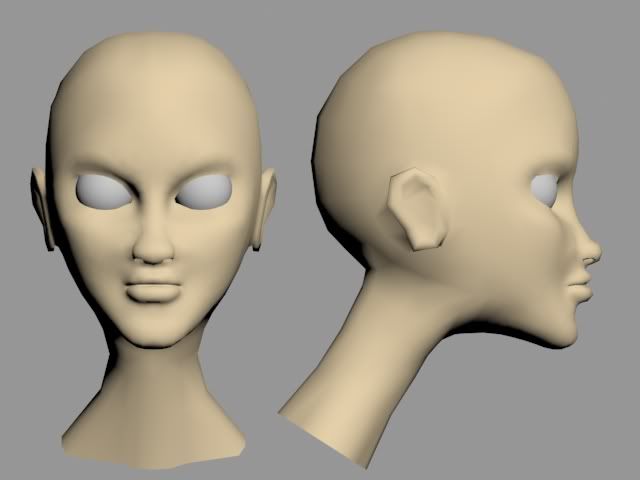
Started with the head, always struggled here.
I think I messed up the anatomy pretty badly but was able to hide these mistakes under the clothes later on.
Progress so far, still need to work on the hair.
Tutorial has been very informative so far and I've learnt so many new things its painful I didn't try these sooner. Hoping to finish it off soon and move onto some more 3D works. I have my own personal projects planned but I might just continue with a few more tutorials depending on how things pan out.
Speaking of personal works, Ive been throwing around an idea for a project for some time now whilst finishing off, "The Art of Games Design" by Jessie Schell. An idea in my head sprialed whilst reading Schell's methods and I started (and didnt finish) some concept stuff for it.
Rough:
Concepts for a game and idea that I didn't finish. Was unhappy with them and couldn't really get it to work, which is annoying.
I still plan on going back to these and finalizing them, maybe.
So engrossed with Design work right now and ensuring everything is running smoothly for our class game, Spin Doctor, which has a deadline coming up, I haven't had much to blog about.
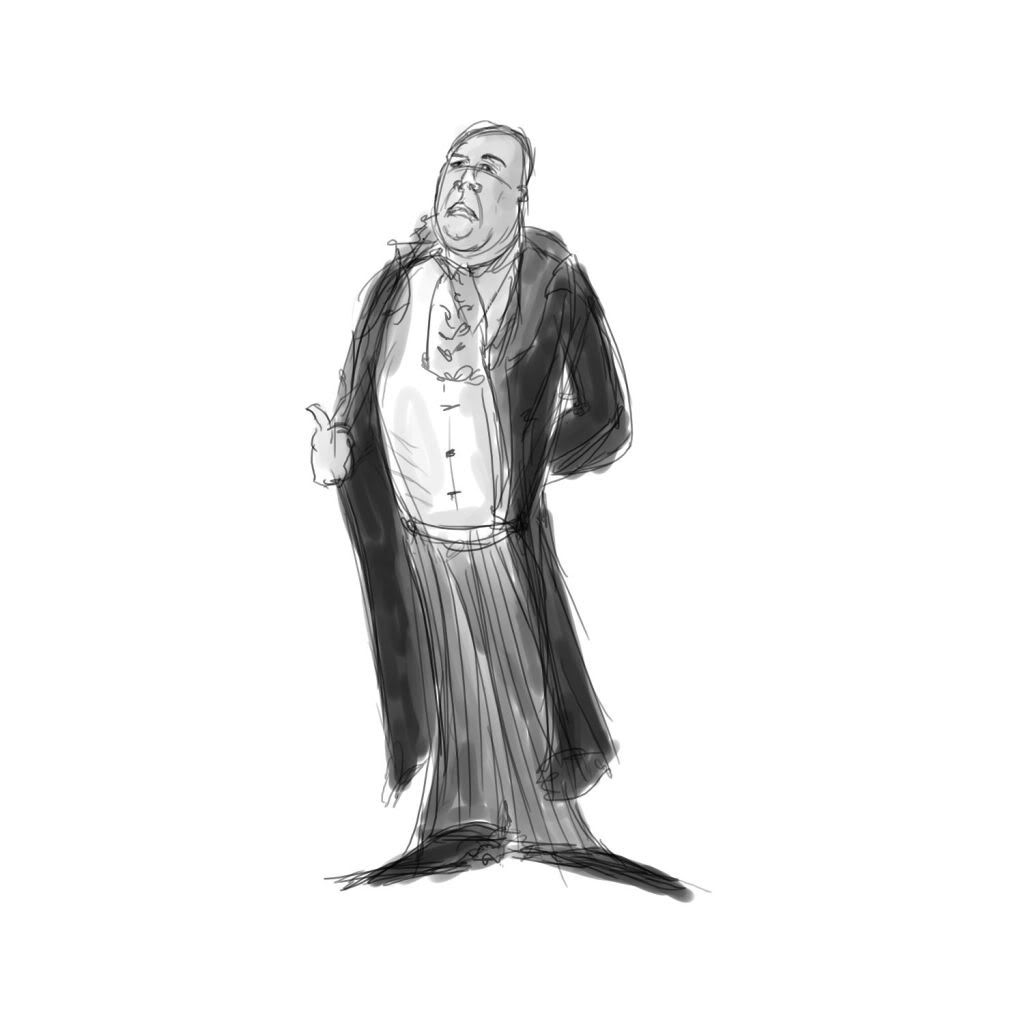
I have been working however, any spare moment I get from college work, on a few side projects. Written up 2 concept docs for fictional games Id quite like to try out in the future. Put a good few hours into learning Unity and refreshed myself with some coding. Ive also been doodling some, not much to show but here are two characters Im working on:
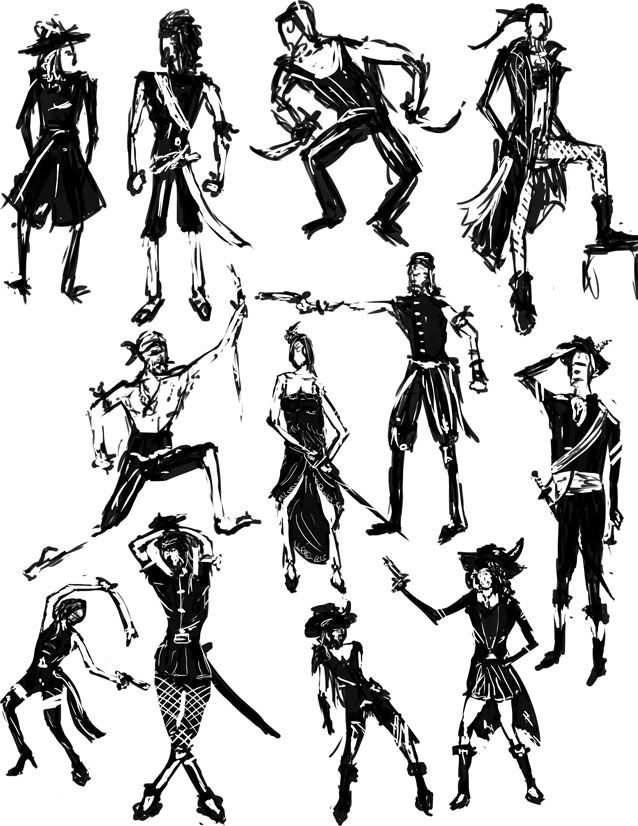
Character from a game idea I'm working on, Pirates although not how you might think.
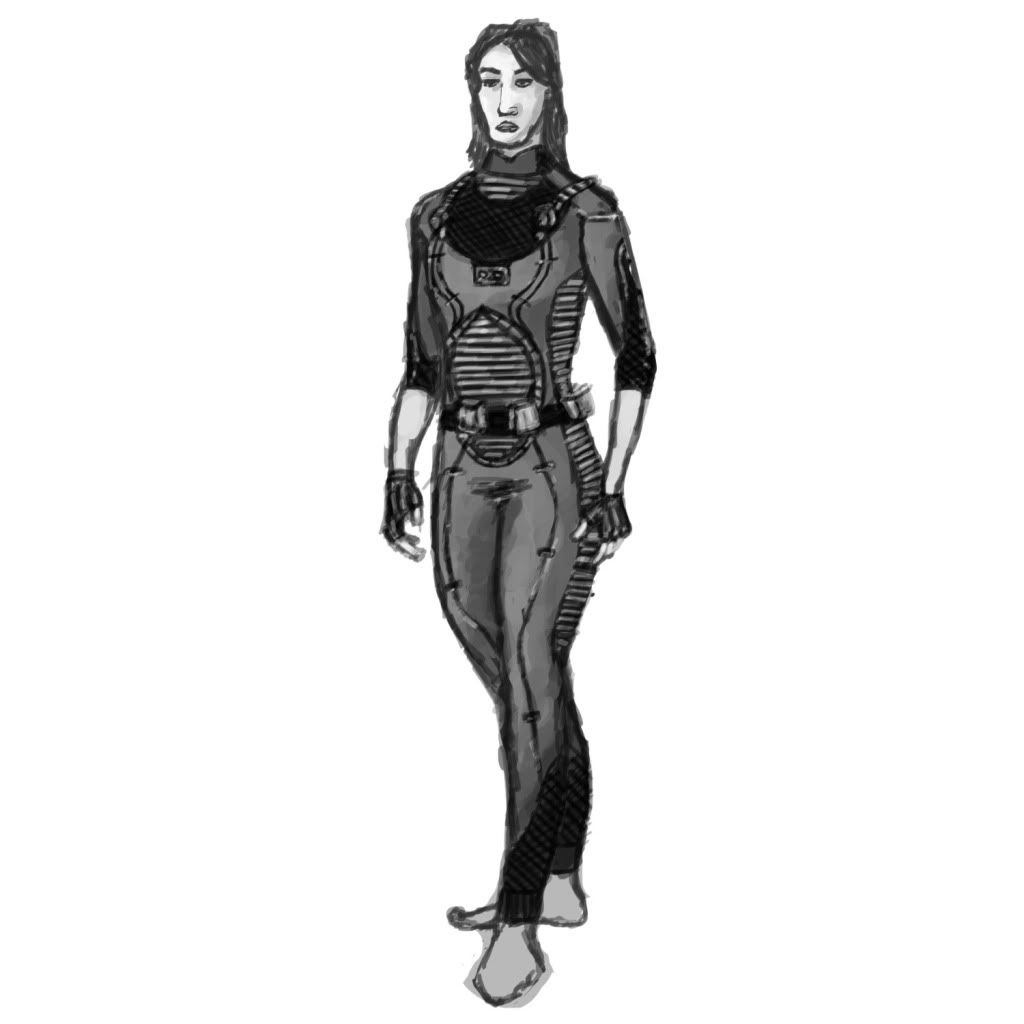
Another character from another game, this time with / for Gina Nordheim. Character is called Anna and is faaaarrr from finished.
Hopefully I should have some more content soon. Ill be drawing more and hopefully the class will have a game to share with everyone.
Bye for now blog, be patient.
Friday, 6 July 2012
Here are some of the Levels I've been working on in the editor, coming along nicely.
I've been a little lapse with posts recently; although thats not through lack of work or effort.
The majority of my time has been spent playing with the editor (and pestering Ben) as well as working on a super top secret Spin-Doctor website with Gina; which is almost done. I've also been drawing alot more, although that's just side projects nothing of which I really want to share on the blog just yet.
Although there are these rough sketches:
Ill try and get some more art updates soon. I am also planning an update with my experiences using the Engine and Editor and perhaps some gameplay of Spin-Doctor; at least my personally created stuff. (Mad props to Ben)
For now, I'm going to try and finish off the website which should be done in a week or so, certainly in time for the Alpha and hopefully in time for MCRGameJam which I'm still waiting for an email back from.
So if you`re MCRGameJam and reading this, email me back man, seriously.
Later.
Tuesday, 12 June 2012
Bit more Art, nothing much.
I rushed this a little because the time I had set aside to do some work I spent playing Max Payne 3:
Anyway, I whipped up a cushioned platform in 3DSMaxPayne for the player to land safely on without taking damage.
These, specifically for the Medical Zone, are meant to emulate the walls of padded cells found in insane asylums.
Perhaps this message is lost a little with the perspective, so I'm thinking that maybe some wall decals need to be added to the background to indicate further that the platform is cushioned.
Not sure, have to see how it looks in game maybe we`ll get away with it.
There are two different versions since I wasn't sure what style of cushion looked best. I liked the dipped cushion better although the difference is that minute it really doesn't matter.
Both versions are in the groups folder so I suppose they are just variants that can be changed in game.
Thats all I've got for now, working on some new platforms and things which Ill upload as they are finished.
Lots of assets getting churned out now by the artists so its looking pretty hopeful we should have a nice looking game by the time Alpha rolls up in the coming weeks.
Ill do another stock count of what we`ve got done and still to do in a few days.
How wonderfully exciting.
Monday, 11 June 2012
Happy to get the paper level design stuff stacked so I can focus a little more on the art.
Having trouble getting myself motivated with this; a little stuck creatively for ideas.
That being said, seeing how well Harry is getting on I've tried to muck around a little tonight.
First up, I made a new platform:
Nothing really amazing, I was just trying to get a more concrete feel which looks more akin to the Medical zone.
Not thrilled with it, but it pays off to have variants of platforms so Ill keep it and make a few more later.
I'm getting really lazy with the texturing; opting to do the majority of the work in Photoshop since half the effort I WOULD have put into 3D is wasted in the 2D game. Shame.
Anyway, with the platform made I mocked up this little idea I had:
Rushed it towards the end and left off some parts I wanted to add like cogs and a candle; I also nicked the steam gauge straight off Google.
Lazy lazy.
This was only a concept but I sort of liked the idea of it, would look funky as décor in levels.
Made a few different ones with various different X-ray scans:
I also made a cracked screen one although again, that was just with a stolen texture. Made this quickly because I wanted it to be a concept but unless anyone has any objects, Ill probably just leave it as is.
Maybe make my own broken glass though, not sure.
Thats all for now, I should probably do a wrap up of the Design work but it wouldn't be much of a post.
Hopefully much more art to come in a few days.
Cheers.
Tuesday, 29 May 2012
After my test concept I decided the door I had done really wasn't fitting for the Medical zone so I mocked one up in 3D / Photoshop.
Just for fun I went about this a different way I would normally texture in that all the texture was done in photoshop with overlays.
Makes for a different result than what I would have been able to achieve in 3D which isn't always a bad thing, although I dunno.
Door is below anyway; the grey-scale is what I took into photoshop and the textured one is what I finished with.
Also shown in the earlier level mock up for comparison.
Starting sketches
Untextured
Final
In-Game Concept
Monday, 28 May 2012
Head was frazzled so I decided to do a little modelling for fun instead of college work all the time, plus Im sick of 2D stuff.
Its lame.
Stayed up till 4am then to make a Gun, LOL.
Its a Beretta; I wish Max Payne 3 was out on PC already....
Might texture this if I find some time, I have unwrapped it although only roughly.
Want to have a go at hand painting it although Ill see how I feel, be a fun exercise in texturing anyway. Assorted images below.
Ill crack on with Spin Doctor stuff tomorrow, now I'm going to sleep.
Sunday, 27 May 2012
Seeing Benjis level concept thrown together with his assets, (which looked awesome btw) I through together the assets Id made (chain is Benjis, Spikes and Saw Blade is Harrys) and a few from others I needed to complete the level.
Was a test, just to see how well things worked together.
Horribly, is the answer, if you were wondering.
Things look really out of place to me and I don't like it. Nothing blends well. I've decided I need to make a new door for the Medical since my current one isn't fitting in style and the background, I'm lost with. Will do for now I guess until I get some inspiration.
The square border looks far to clean, I am aware of this and its on my to do list.
I'm not that unhappy with the platforms, although they are still meh.
In order to place the assets better in the level I added a slight drop shadow. I rushed it and its too strong in areas, like the chain, but I needed that to stop it looking so flat.
I'm not sure how we can go about this from a programming perspective.
The only plan I've got is to render drop shadows on all individual objects and save them off as PNGs, hopefully being able to use Opacity data inside the Engine. That would be a rough way to solve the problem but could look a little off, would need to test it in the engine.
Anyway, whatever, the concept:
Any excuse to use Harland Shears in an image:
All so very Meh.
Meh, Meh, Meh.
Saturday, 26 May 2012
Assorted items, again lazy texturing; sprucing them up in Photoshop is the name of the game.
Friday, 25 May 2012
Trying to do some art, but I cant really get focused with it.
We need a square girder to contain the room, I just wanted something simple that didnt take to much attention away from the player but was still fitting with the theme.
Heres what I'm working on anyway, Id like Ben to put it into the engine so I can see and take it from there, but I fear in the interests of time and speed it might have to be as is.
Sloppy as fuck with the textures, I just cant concentrate and there is no way I can Unwrap right now, heh.
Yay for Gizmo.
/thatwilldo.
My first draft of the square room boarders, just threw some textures on there and rough designs to get a feel for how I wanted it to look. Pretty lazy but it was a starting point.
Decided that a more wooden and bronze look would be better suiting to the style of the game, although I feel this can be changeable depending on the level. (With each level having its own theme.) This means the wooden version is probably better suited to Level 3 which is the Mansion Zone, although can exist as standard for now.
Im going to grunge these up a little since they look too clean, but I figured that would be an easier task in photo shop rather than putting that detail into the texture work; which I dont have the patience for right now.
I want to see how it looks in game first and then continue with this, right now Ill get on with other stuff.
Tuesday, 22 May 2012
Started a few levels going to finish the first iteration of them all tonight I think. Ill upload the few I've done quickly now.
No idea why blogger feels the need to rotate them for me, but Ill fix that later.
Room 1 This first level below was one of mine, played through it and decided it was to brief and to easy to complete. Whilst there as a little element of puzzle, one figured out the level would last only a few seconds. Which is boring.
I've added in a few extra traps in areas to make it possible to die in the level, aswell as removed two of the doors so you cant get stuck.
I plan to go over this level again a second time and try to beef out the puzzle factor to it somewhat, make it more of a challenge.
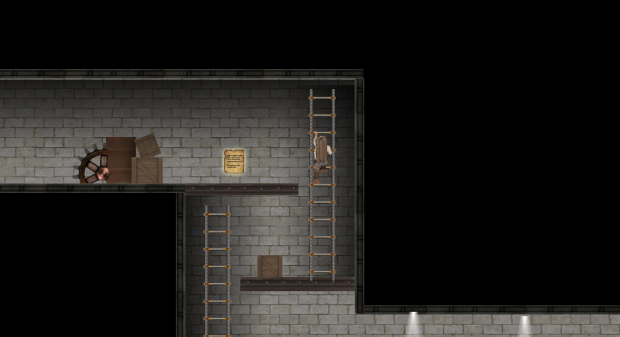
Room 2 Next up was on of Adams. Mainly I changed a few problems with height and location of platforms. I moved the ladder higher up in the latter half of the level to make it more of a challenge traversing the land. In terms of redesigns, I made the initial falling platform trigger activated via a wall switch aswell as moved the location of the note so its more accessible to the player and covers some dead space.
Make second run through of this I want to focus on the latter half of the level and make some additions.
Cross 1 One of my cross sections. I couldn't find anything totally wrong with this. The design works but it might be a little short and not keep up with the spirit and point of the cross sections. I might ask for some additional eyes to look at this and see what they think.
Some additions I made was adding a trap door rather than an open panel triggered via a switch. This just means the cross section lasts that little bit longer and encourages the player to explore more.
Cross 2 This was one of Marks. I actually really liked this one and didnt feel many changes were needed at all. The onyl problem I found with the section was the moving platforms would move too close to the walls, blocking to fall path of Harland. This is easily fixable by haulting the moving platforms just before the edge, letting the player jump down.
Ill get the rest done for tonight and arrange them into presentation form for Wednesday. Then with these done and after Wednesdays lesson Ill go over my work and make any further changes.